Writing
Substack
Works done by creatives: an archive.
Works done by creatives: İpek Duben
Collecting a big archive here rather than in my brain.
I like to collect creative works.
It’s like trying to understand myself through what I’m drawn to: a lifelong scavenger hunt for meaning. I’ve always loved the esoteric, the raw, the ones that don’t beg to be liked. Sometimes it’s a book, a note, a piece of video art. Sometimes it’s just a line that stays with me longer than I expected.
While reading, I realized I wanted to build my own space: a mass of inspiration collected from people doing deeply human things. This page is about that: inspiration, perspective, and the art that crawls under your skin.
For my first piece, İpek Duben felt like the only right choice, a voice that’s both political and painfully intimate.
İpek Duben
İpek Duben is an installation, painting, sculpture, and video artist whose work moves through the crossroads of politics, sociology, and art. Every piece she makes carries a pulse: sharp, critical, emotional.
Since 1994, she’s been creating artist’s books: raw, experimental pieces that explore identity, domestic violence, and migration. Many expand into installations woven with sound, light, and moving image.
There’s something magnetic about how Duben uses form as protest, turning silence, fabric, and even walking into acts of resistance.
ŞERİFE #6-7-8, 1981
Who is Şerife? “… a house cleaner from an Anatolian village, abandoned by her husband, migrated to İstanbul for her son’s education.”
I love Şerife because it’s not just a painting, it’s a quiet kind of revolution.
In Duben’s hands, Şerife becomes a symbol of unseen labor: women who clean, feed, and hold up the world while being erased from it. The soft pink dresses in the painting breathe without bodies; they carry exhaustion, care, and survival. Every fold feels like a memory. Every seam, a prayer.
Women like Şerife, doing domestic work, are rarely called by their names, just “the woman.” Duben refuses that anonymity.
She once said, “Her absence was her signature; the dress was a metaphor for the average lower-class Turkish woman and came to represent all women denied their rightful place in society.”
Şerife isn’t about presence, it’s about absence, about how even emptiness can scream when painted truthfully.
Follow the Arrow
Site-specific installation, Tünel/Beyoğlu, Istanbul. 347 painted metal arrows lead pedestrians to art venues in Tünel and Asmalımescit neighborhood. Every yellow arrow points to movement, migration, and the quiet politics of public space.
Follow the Arrow turns a walk through Beyoğlu into something more than movement: an awakening. Duben’s yellow arrows guide us through streets and cafés, tracing the invisible routes of women, workers, and outsiders. Each arrow is both a question and a direction, a quiet reminder that even walking can be political.
Artemis II, Ephesus: The Imagination of History, Ephesus, 1995
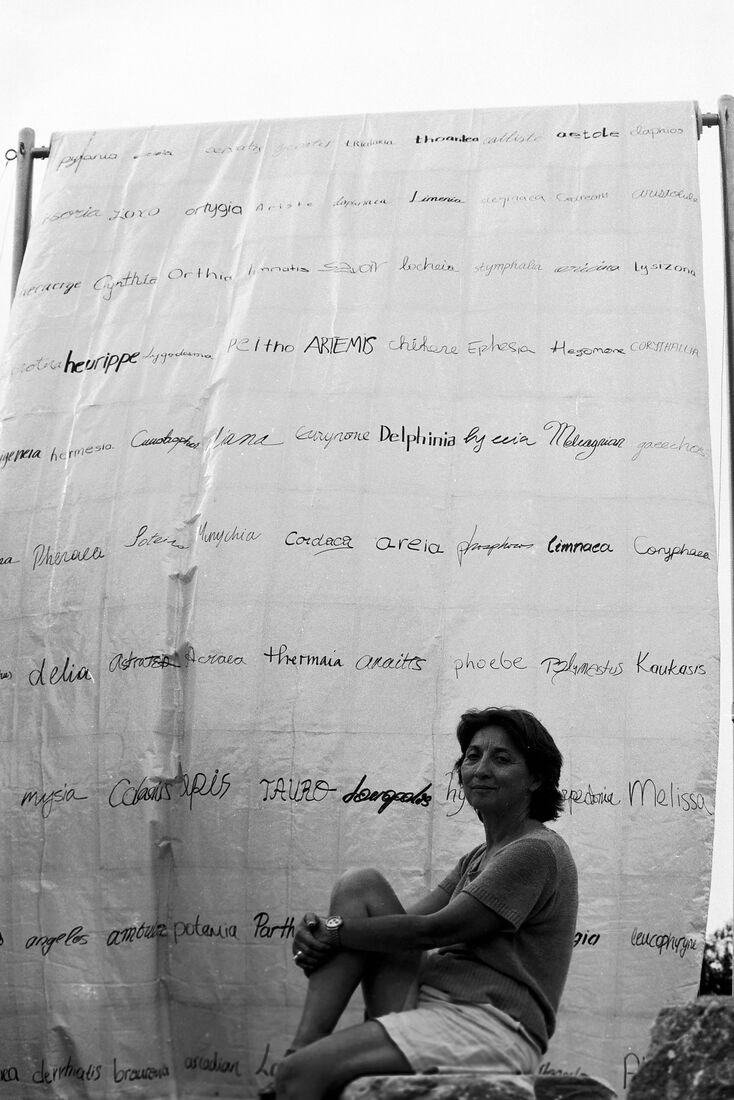
In Manuscript 1994, Duben begins with her own photographs, layering them with mixed materials, offset printing, and digital interventions to question what identity really means.
A year later, she reimagines one of these images in Artemis (I.n, 1995), created in Ephesus for the Imaginary History exhibition. Through it, she reflects on how women have always been framed: both worshipped as goddesses and sacrificed as victims. The duality is timeless, brutal, and still alive today.
LoveBook (detail)
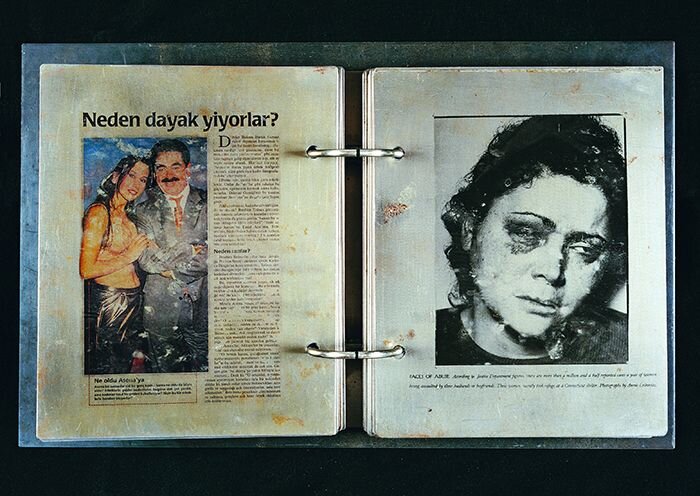
LoveBook hits like a bruise that never fully heals.
Here, Duben collages tabloid headlines, bruised faces, and fragments of women’s stories; the kind of images we’re trained to look away from. “Why are they beaten?” one page asks. But the question isn’t seeking an answer, it’s holding a mirror.
Duben doesn’t document violence; she indicts the culture that normalizes it. The glossy magazine photo beside the battered face says it all: how easily glamour and pain coexist in the same visual frame.
LoveBook isn’t about victims. It’s about the systems that keep producing them and the silence that follows.
İpek Duben makes art that doesn’t let you stay comfortable. Her work lives at the fault line between beauty and brutality, where fabric becomes testimony and walking becomes a protest. She’s not making art to decorate; she’s making art to witness.
And that’s why I love her, because she reminds me that empathy too can be a political act.